This is the first module of the Yoga.org certification, exactly as the paying cohort receives it on October 1. It's free, it's complete, and there's nothing to buy at the end of it. Read it and decide for yourself whether the rest is worth your money.
Status: drafted, not yet faculty-approved. This text was drafted by AI against a set of learning objectives and cross-reviewed by several models. It has not yet been reviewed and signed off by a practicing teacher. When it is, this box will be replaced by the reviewer's name and the date they approved it. We'd rather show you the work in progress than pretend it's finished.
Every module is narrated. In the course you can have it read in a voice you choose — or, if you record a short sample, in your own.
Prototype: this is a synthesized narration of the section below, generated from the module text. Voice cloning is not enabled on this page.
This is the single most common surprise for new teachers, and it's worth confronting before you spend money on a training.
A strong practice makes you good at doing yoga. Teaching is a different job: you watch other people's bodies instead of feeling your own, you talk continuously while they move, and you make decisions in real time about people whose injuries, histories, and limits you mostly don't know. Many excellent practitioners are, at first, poor teachers — not because they lack knowledge, but because they've never had to externalize it.
Four capabilities do most of the work, and they're what this certification is built to develop:


Notice that only one of those is about knowing poses. The knowledge base matters — you'll need anatomy, philosophy, history, and Sanskrit — but knowledge is the cheap part. Judgment is what you're really buying, and it's why the final assessment in this program is a recorded class reviewed by a human being rather than a multiple-choice test.
"Yoga teacher" describes at least four distinct occupations. This program treats them as separate paths because the day-to-day skills genuinely diverge.
 In-person class
 In-person one-to-one
 Online class
 Online one-to-one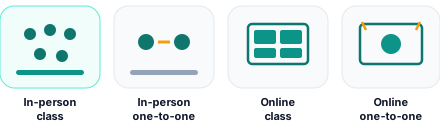
One-to-one work in homes, studios, or outdoors. Highest hourly rate, lowest volume. The skills that matter most are intake and screening, hands-on assessment, and adapting a plan across weeks for one specific body. You need to be comfortable asking direct questions about injuries and medication, and comfortable saying "that's outside what I can help with."
Leading a room, usually of mixed levels. You mostly can't demonstrate and observe at the same time, so verbal cueing carries the class. You need sequencing that works for a range of bodies simultaneously, a plan for the person who shouldn't be doing what everyone else is doing, and — practically — the ability to audition and get on a studio schedule.
Same relationship as in-person privates, but you can only see what the camera shows and you can never touch. Cueing has to become far more precise, and camera setup, framing, and sound stop being technicalities and become teaching tools. Scheduling across time zones and taking payment internationally are part of the job.
The widest reach and the hardest to make a living from, because you're competing with free. Works when it's built around a specific audience or specialization rather than "general yoga." Retention, community, and a repeatable format matter more than any single class.
You'll be asked which of these you're aiming at before your path is built. You can change it later, and you can train for more than one — but the honest advice is to pick the one you'll actually do first, get competent, then add.

This part is uncomfortable, and we'd rather say it plainly than let you discover it later.
Nobody licenses yoga teachers. There is no government body, no legally protected title, and no examination you're required to pass. Anyone may lawfully teach yoga tomorrow without any training at all, in most of the world.
Yoga teacher credentials are issued by private organizations. Yoga Alliance, a US trade association, maintains a widely used registry of participating teachers and schools. Yoga.org is not registered with Yoga Alliance and issues its credential against the public standard described below.
So what is a credential worth? Exactly as much as the standard behind it, and the willingness of the issuer to enforce that standard. That's the bet we're making with this program:
Two things we will not claim, now or later: that we are government-accredited, and that we are equivalent to or recognized by Yoga Alliance. If a studio requires Yoga Alliance registration, our credential does not substitute for it. Some employers will care about that. You should know it before you decide.
 Walk around it — 360°
 Alignment layer
You should know how the material in front of you was produced. We publish that process with the curriculum.
Every module in this certification is drafted by AI and reviewed by practicing teachers before release. Concretely:
AI helps with recall, research breadth, structure, and early drafting. It cannot watch a knee collapse inward and know to intervene, or tell you that a cue which reads beautifully confuses everyone in a real room. That judgment layer is human, and it is where the review step earns its place.
That's Module 0 in full. Nothing was withheld and nothing unlocks if you pay.
If it was useful, the rest of the certification runs as a cohort of twelve weekly learning cycles beginning October 1, 2026, capped at 40 candidates, built around a path assembled from your own experience. You can see every module and its current review status on the curriculum page — including the ones we haven't written yet.
If it wasn't useful, you've lost nothing, and the Yoga.org library stays free regardless.
